


Thermal fatigue in deployable shield joints: analysis with Adams and Inventor
The recent failure in the deployment mechanism of a foldable heat shield during an atmospheric reentry has highlighted a critical problem in space engineering: joint jamming due to differential thermal expansion. This incident, simulated using multibody dynamics in MSC Adams and CAD modeling in Autodesk Inventor, reveals how extreme temperature variations generate stresses that exceed the material’s fatigue limits, compromising the system’s integrity.
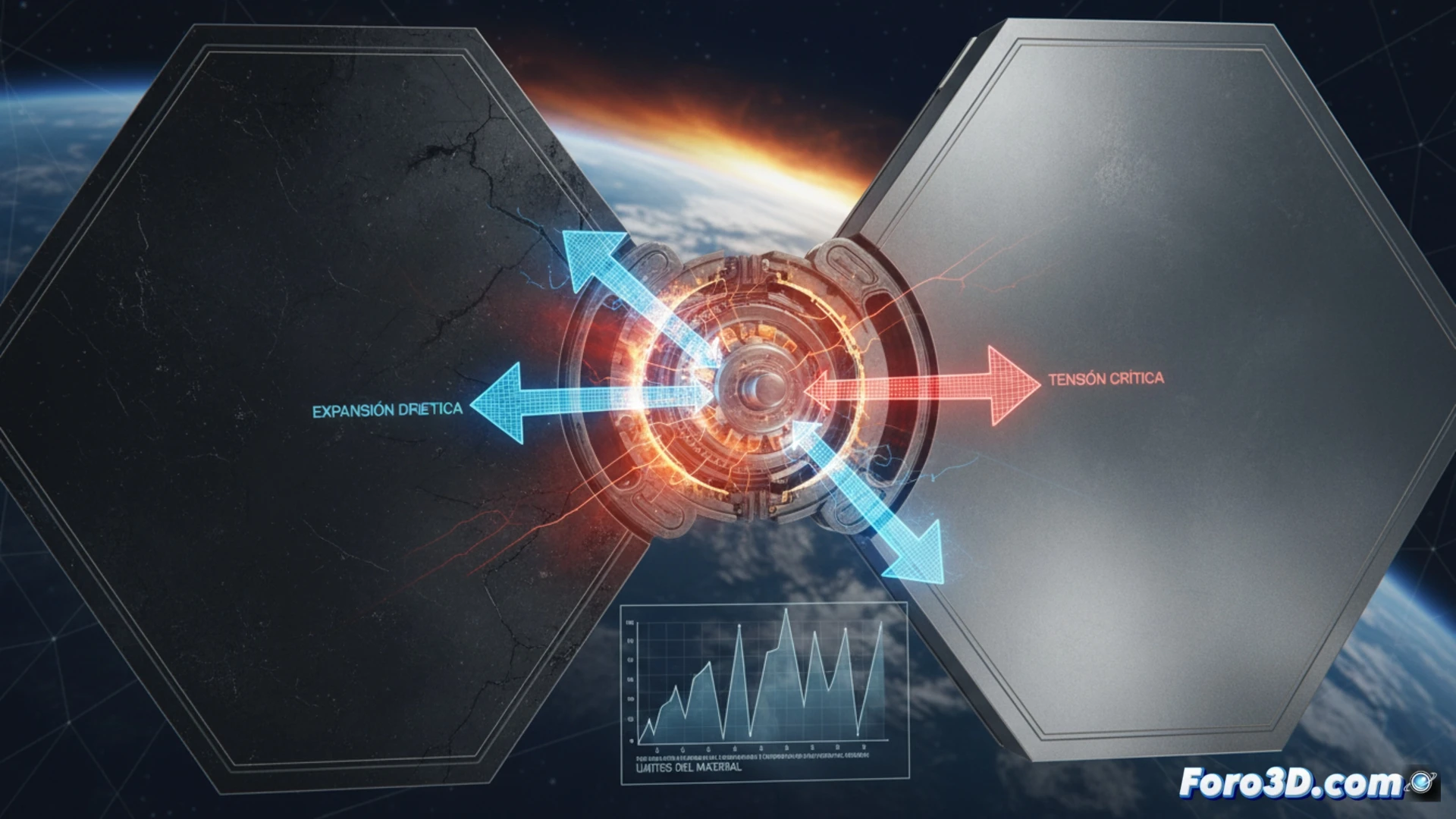
Simulation of jamming due to differential thermal expansion in joints 🔥
The analysis began with the laser reconstruction of the failed prototype using ReCap Pro, generating a precise point cloud for the CAD model in Inventor. In MSC Adams, contacts between the shield segments were defined, and thermal loads simulating the reentry profile were applied. The results showed that the thermal expansion coefficient of the joint materials, although similar when cold, diverged upon exceeding 800 degrees Celsius, generating progressive wedging. The fatigue simulation identified that the repeated expansion-compression cycle in just 120 seconds of reentry exceeded the elastic limit, causing plastic deformation that jammed the mechanism before full deployment.
Lessons for designing high-temperature tolerant joints 🛠️
The key to avoiding this failure lies in predictive thermal fatigue simulation. The multibody model in Adams allowed iterating over joint geometries with controlled clearances and low-expansion materials, such as carbon-carbon composites. By integrating the cyclic fatigue results into the CAD redesign in Inventor, a joint was achieved that maintains its functional clearance even under the extreme thermal gradient. This case demonstrates that fatigue simulation is not just a complement, but the cornerstone for validating space mechanisms subjected to thermomechanical stress.
What multiphysics simulation techniques in Adams and Inventor do you recommend for modeling the effect of extreme thermal cycles on fatigue in the joints of a deployable shield during atmospheric reentry?
(PS: Material fatigue is like yours after 10 hours of simulation.)
Read more here: Source link