


[Interview] Miller Puckette, USA (original author of ‘Max MSP’ and ‘Pure Data programming language’, professor at UC San Diego)
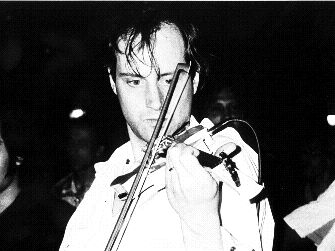
Miller Puckette is a distinguished professor emeritus at UC San Diego and the original author of Max and Pure Data (Pd). Pd is an open source visual programming environment for real-time audio and data processing. It runs on Linux, Windows, macOS, mobile devices and embedded boards, and it is used in interactive music and video, biomedical processing, data analysis and neural network projects. Pd has later extended into interactive video language and has remained a total leader in visual entertainment for large festivals and music concerts worldwide. Pd and Max MSP are still considered as a total industry standard in real-time signal processing in audio, engineering, and scientific research globally to this day.
Table of Contents
You started Max at IRCAM in the 80s, and it was later commercialized by Opcode and then Cycling ’74 but then later you wrote Pd from scratch. Did you solve some limitations of Max, or simply wanted the software to be more open and available? What was life like in those turbulent times, I guess those power moves can be quite stressful.
Both! I regretted some design decisions I had made in Max and made them differenty in Pd. But also, I wanted to have a very small program (Pd can now run on tiny machines such as ESP32 boards). AND I saw that it had become possible to distribute free software in the mid 1990s, which was not really feasible when Max first came out. It’s so much easier to manage an open-source free software than one where you have to print and distribute disks, as we did in 1990. So Pd became open source free software.
Did work at the University make it easier to keep Pd open and free, or was that a struggle of its own? Is it easier to maintain active software as a teaching professor or working in the industry?
UCSD told me I could do anything I wanted. It was much easier than it would have been if my work had been owned by a company. Max was owned by IRCAM, whereas when I moved to UCSD I was allowed to own my own work. Much better!
Pd uses a permissive license, not the GPL. The Linux world is strongly GPL. Did the Linux community push back on that choice, and why did you choose this license?
I chose BSD because I wanted the Max maintainers to be allowed to use Pd code. I’ve never had any reason to want to restrict who could use my work – quite the opposite: the more it gets used the happier I am. If anyone wants to use Pd under GPL I could easily release it under that license as well as BSD, but nobody has asked me to do that.
The Linux community was built around system administration and security, and you were working with real-time sound processing. Did you feel isolated early on? When did Linux users start to embrace Pd as their own?
I had released Pd for IRIX (a version of linux) and for Microsoft Windows. It was Winfried Ritsch at IEM, Graz, Austria, who got it running on linux and showed me how to get linux running on my own PC. I liked it much better than either windows or IRIX so linux became my own main platform. I still compile Pd for other OSes of course. I want it to be available for anyone to use regardless of operating system.
Then Pd also started to be used in video generation and interactive light systems for festivals, music concerts, rave parties, and VJ performances. How did that affect you, this must have been an insane ride into a totally new territory.
Actually I wanted that to happen, and that was one reason I left IRCAM – they had a policy of not releasing graphics or video software, but UCSD had no such restrictions. I had been wanting to add image synthesis to Max, but moving to UCSD gave me the chance to work seriously on that.
Did Pd’s core architecture need any changes to handle heavy OpenGL/video tasks alongside real-time audio without causing audio dropouts? Also, are there much differences between various GPUs?
No changes necessary; but it can help to use pd~ to isolate the graphics load in a separate process from the audio processing since it often requires higher latency than you want in the audio process. I’ve personally never overloaded the graphics pipeline so I don’t know which graphics cards run best.
Pd runs on every major OS and many embedded devices now. Was the community built mostly on mailing lists, workshops, or something else? Was it difficult to oversee all those communities and projects? Does it get overwhelming and how can one cope with that? Most devs that I know abandon their own projects because of a burnout in just a few years.
I think the burnout comes from having written large programs that become hard to manage. I keep Pd small and simple in order not to burn out. There are many channels such as mailing lists for Pd – I follow some of them. The people I hear from are almost always polite and respectful of others, so there’s no big difficulty keeping up with it.
Pd’s GUI was built with the Tcl/Tk toolkit. What were the pros and cons back then compared to Qt for example. Has the GUI ever changed? Did it have to be rebuilt for new versions of Windows/Mac/Linux? I only know it looks a bit different on mac but to me it always looked the same on Linux and Windows.
The big pro is that Tcl/TK has been very stable for the 30 years I’ve been using it. Of course things evolve but it’s been easy to keep it running. I think any other toolkit would have forced me to migrate by now. At the same time I now have a GTK version of Pd I’m using experimentally, as a way of making sure that it will be easy to move Pd away from Tcl/TK if that ever becomes necessary. But I notice that both QT and GTK go through incompatible changes frequently, so perhaps Tcl/TK will end up being the longest-lasting GUI toolkit after all.
Since you’re testing an experimental GTK interface to future-proof the UI, how strictly is Pd’s audio DSP engine decoupled from the GUI process today? Did that client-server split make it easier to experiment with a completely different frontend?”
It’s very strictly separated – at the moment the audio process doesn’t even know whether it’s talking to the TK or GTK front end. And yes, the highly decoupled design made it quite easy to run alternative GUIs, or run a GUI on a remote machine, or run with no GUI at all.
Pd has several forks and distributions, such as Pd-extended and Purr Data, and mobile wrappers like MobMuPlat and now some newer HTML5 ports. Did all that split help or hurt the project and how can you even follow all that activity?
I can’t follow it! These things come and go. Meanwhile I find it easier to just focus on Pd itself, which changes much more slowly than any of the offshoots.
libpd made it possible to embed Pd in phones and embedded boards. Now Pd is a data processing runtime, used in biomedical work and neural network projects. Do you follow those implementations? I see it in science laboratories often, but usually the MAX MSP version, why not Pd directly? I always ask them and they usually just say that their lab purchased MAX, why not Pd which is free and better supported.
Pd is much easier to embed in other software than Max is – that’s one of my design criteria in working on Pd. Of course people use Max in schools and labs because Max follows a software distribution model that bureaucrats can understand. Pd appeals more to hackers and makers and certain researchers who want more freedom in how they can distribute their work.
Adoption across so many hardware targets is hard to track. Do you keep the core small and let the community maintain the ports? How do you organise your brain to follow all that? Most of us hardly keep our own projects organised.
I only really support three targets – OSes (Mac+PC+linux), libpd, and embedded systems (espd). Others can always compile Pd for their own platforms but I think if I can keep Pd running on this small set of platforms it should be easy enough for other people to adapt it to their own systems.
Getting real-time audio running on tiny chips like the ESP32 requires tight memory and math optimizations. How much did you have to adapt Pd’s core to fit into that tiny footprint without breaking compatibility with standard desktop patches?”
Memory is indeed quite tight, especially on the older ESP32 chips where you can’t have large arrays or stream from or to a filesystem. Patches have to be pretty compact. I don’t think it’s possible yet to run patches with their GUIs open, even remotely. Also, since there’s no double precision hardware support it was necessary to write new versions of certain tilde objects like the oscillator to use single precision. The result maintains somewhat less precision than do the “standard” tilde objects using double precision arithmetic. So you have to cut certain corners to develop patches to run on an ESP32, but it’s still able to do quite a lot.
Besides 7000+ academic citations you also published a book “The Theory and Technique of Electronic Music” and gave it for free online. What helps software get adopted more – community forums, academic publishing/lectures, or a book? We who were active in mailing lists in early years called it “the book”, almost treated it like a bible.
I don’t really know… and now there are also 200 or so hours of videos of my classes at UCSD – I have no idea if people are using those or not either. I just put it all out as well as I can manage and hope for the best.
Can you suggest some cool communities to join for creative people who like to discuss signal processing, sound, and creativity. I see pd in almost all conferences like a backbone, so there must be some cool online places where these people meet.
I think local hacker spaces. I always find that physical meeting locations are better than anything online for sharing knowledge. Of course that doesn’t answer the question for people living in isolated locations – I wish I had a good answer for them as well but I think the communication channels online are always shifting and I can’t really follow them.
Where can people follow your latest work, lectures, publications or possibly some social activity?
I’ve got lots of stuff (like those 200 hours of videos) on my very old-fashioned website 🙂