


[Interview] Curtis Roads, USA (Pioneer of microsound research, granular synthesis innovator, author of The Computer Music Tutorial, editor of the Computer Music Journal, and co-founder of the International Computer Music Association)
Curtis Roads is a computer music composer and researcher specializing in granular and pulsar synthesis. He authored foundational texts including The Computer Music Tutorial and Microsound, developed software like PulsarGenerator, and composed works such as Point Line Cloud. His contributions extend to institutional leadership, having served as an editor for the Computer Music Journal and helping establish the International Computer Music Association.
Table of Contents
You pioneered the concept of pulsar synthesis. In layman’s terms for our listeners, how does generating sound from non-sinusoidal waveforms fundamentally change the resulting timbre compared to traditional synthesis?
One must first understand that pulsar synthesis is a microsonic or particle-based technique. Pulsar synthesis emits a sequence of pulsar particles p consisting of a waveform or pulsaret d followed by a silent period s. See figure (a).
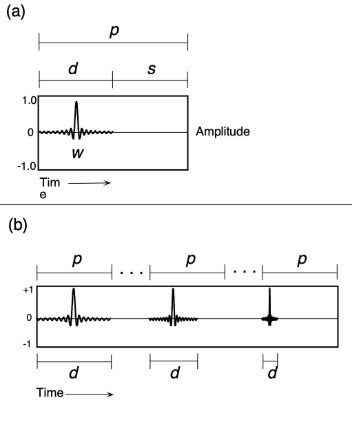
The rate of emission of the pulsars is the fundamental frequency. Pulsar synthesis extends the range of fundamental frequency from the infrasonic or rhythmic range and up into the audio frequency range. So pulsar trains cross the boundary between rhythm and tone.
But this is just one aspect. By varying the duty cycle of the pulsaret in relation to the silent period one creates the effect of a changing formant frequency above the fundamental frequency. It is as if there is a filter sweeping but there is no filter in this circuit. See figure (b) above.
Taking this further one can stack several pulsar trains at the same frequency but with different time-varying formant frequencies. This is not like anything in nature.
Moreover one can assign each pulsar train to its own spatial path so you have one tone with several independent formants and independent spatial paths.
The pulsaret can be any waveform: sine or any sample. Finally one can convolve pulsars with sampled sounds to impose a filtering effect on that sample whilst also transferring the rhythmic pattern of the pulsars to the sample.
Your work on atomic decompositions uses matching pursuit algorithms to approximate signals. Could you explain how this functions like an “eigenvalue” problem for sound, and why finding the optimal Gabor atoms is crucial for analyzing complex acoustic structures?
We need to put this in the context of granular synthesis. Granular synthesis was first proposed by my teacher Iannis Xenakis in the 1950s after the theory and experiments of the physicist Dennis Gabor. Granular synthesis makes sounds by combining dozens or hundreds of short-duration grains of sound. The grain waveform can be as simple as a sinusoid or as complex as a recorded sample. Xenakis made a piece with granular synthesis in 1959 using hundreds of snippets of analog tape. I took his short course in Formalized Music in 1972 in which he talked about the theory of granular synthesis. I managed to implement granular synthesis on a computer for the first time in 1974. Due to the state of computer sound synthesis technology in this period it was a difficult process. Over time I have designed several iterations of granulators, which of course now work in real time. Our program EmmisionControl2 came out in 2020 and I am now working with a PhD graduate on a new one with MIDI note control and support for microtonal scales.
In 2003 a graduate student, Garry Kling, alerted me to the technique of matching pursuit decomposition with time-frequency dictionaries pioneered by Mallat and Zhang. It was immediately obvious to me that this was an analytical counterpart to granular synthesis.
My work with atomic decompositions was always a collaboration in which I provided aesthetic direction, culminating in the app called SCATTER for interactive transformations of analyzed sounds that I hoped to use in my compositions.
The technical implementation was carried out by my students Garry Kling, Aaron McLeran, and Bob Sturm in collaboration with faculty colleagues in Santa Barbara (John Shynk) and Paris (Laurent Daudet).
Atomic decomposition of sound and the eigenvalue problem share the same core mathematical goal: breaking down a complex object into a weighted sum of fundamental building blocks. In audio signal processing, atomic decomposition breaks a complex sound wave down into elementary acoustic components called atoms.
These atoms derive from a predefined dictionary of millions of sound particles. The matching pursuit algorithm tries to match the energy of the input signal to atoms in the dictionary. When it finds a match it removes that atom from the input signal and begins a new search until the input signal is reduced to a residual at a threshold defined by the user.
In our work, Gabor or Gaussian bell-shaped atoms were one type of atom but we also used spikes (Dirac impulses) and long sinusoidal atoms. The spikes were well-matched to noisy transients while the sinusoidal atoms matched pitched tones. One can imagine other types of atoms such as glissons for changing frequencies, damped sinusoids for percussive pitched tones, and fractals for noise. A heterogeneous dictionary is best for musical analysis and reconstruction.
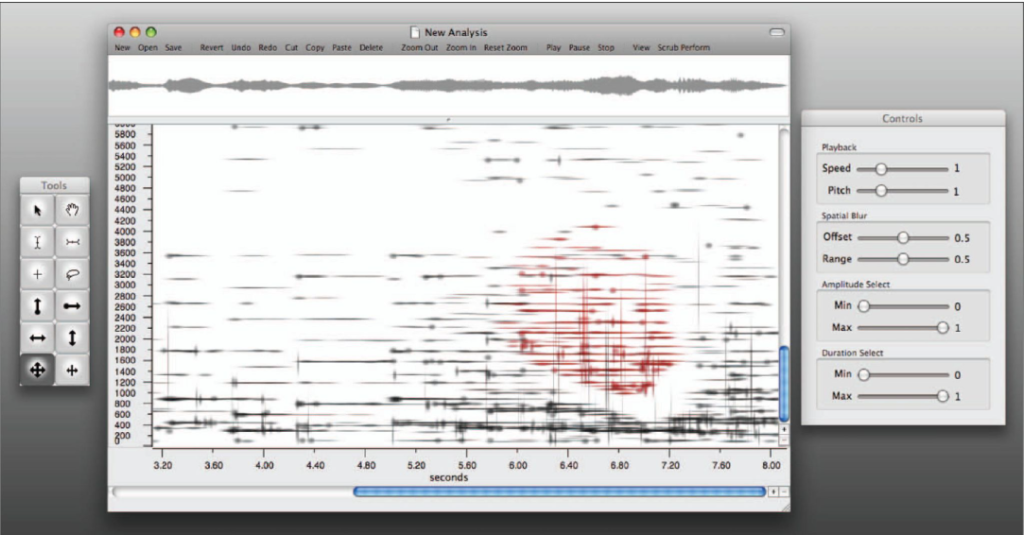
The result of an analysis is a list of atoms with start times and durations, etc. Our interactive app SCATTER could display this list as a time-frequency graph like a sonogram that we called a wivigram. Since the list was just text it was extremely easy to manipulate this list interactively (i.e., select only the longest atoms, which tend to be harmonic) and instantly resynthesize variants of the input using additive synthesis of the atoms in the dictionary.
The development of the interactive SCATTER app was the highlight of our research for me. We received a Best Paper award at the 2008 International Computer Music Conference. Unfortunately, soon after this, the project fell apart. The student who developed that SCATTER app took it upon himself to “clean up the class structure” of the working C++ app, which broke it. The working version was lost in the process. This student then abruptly left our doctoral program at UCSB to pursue a career in the game industry, leaving us with a broken app. I was never able to do anything creative with this powerful tool.
We applied for additional funding from the National Science Foundation to continue to pay graduate student researchers but this was denied so our progress was blocked. I had other obligations so I moved on to different projects.
The basic matching pursuit decomposition algorithm is quite powerful as a first approximation of the atomic structure of a sound but it has flaws and limitations. I have always believed that these flaws and limitations could be greatly reduced with additional research. In 2008 we were limited by computation speed; our analyses could take up to 200 times the duration of the input signal. Today variants of MP have been successfully implemented on GPUs with massive speedups.
Another problem is that sparse decomposition algorithms like MP iteratively build a signal model using atoms selected in a locally greedy manner. Some terms in the estimation appear as a result of this greediness. In the extreme case, some atoms may exist in regions where the original signal possesses no energy. These terms remain a part of the estimation but destructively interfere and “disappear” in the reconstruction. Because of the disappearance of atoms in the extreme case, we referred to interference between the terms of a sparse atomic estimation as dark energy. Although other atoms may not disappear, they may still exist to “correct” other atoms through constructive and destructive interference to preserve the waveform of the original signal.
The orthogonal matching pursuit (OMP) is another greedy algorithm. The core difference between MP and OMP is that MP only updates the single newly selected atom, whereas OMP updates all previously selected coefficients at every step–greatly reducing the problem of dark energy. OMP is much more demanding computationally, so in the period we were pursuing our research it was much less attractive. Since that time OMP has been greatly sped up and is therefore more practical.
I have not followed the field closely over the past decade but I am still not aware of an app like SCATTER for interactive spectrum transformation.
You developed the PulsarGenerator software to demonstrate your theories. When designing tools to manipulate sound at such a microscopic level, how do you balance mathematical precision with intuitive control for the composer?
I don’t see an opposition between precision operation and intuitive control. The synthesis engine must be precise in order to be predictable. All of the low-level microsonic details are handled by the synthesis engine. The controls, which in this case are envelopes, usually operate on the meso time scale, i.e., from about eight seconds to a minute (the time scale is set by the user). One can be manipulating the envelopes while the system is running so there is always immediate feedback.
Granular and pulsar synthesis are frequently layered behind prominent melodic leads in contemporary production. How do you feel about this integration of microscopic textures with traditional musical structures?
I heard an advertisement for a Mercedes-Benz convertible that combined a traditional pop beat and bass with cadences of stochastic noisy granular synthesis. I thought it was effective. As in all music, it all depends on who is using the instruments and how they are using them more than the instruments themselves.
What do you think is the future of the merging of analog sinusoid like sounds with granular or pulsar elements to create more powerful timbres?
Of course. Why not?
Where can people follow your work, your updates?
The newest book is The Computer Music Tutorial, Second Edition, 2023, The MIT Press
The newest album is Curtis Roads: Electronic Music 1994-2021, Elli Records