


[Interview] Robert Henke, Germany (co-creator of Ableton Live, developer of Granulator for Max for Live, designer of Monodeck MIDI controllers and the Firebird 8-bit computer, taught at the CCRMA/Stanford, and Berlin University of the Arts)
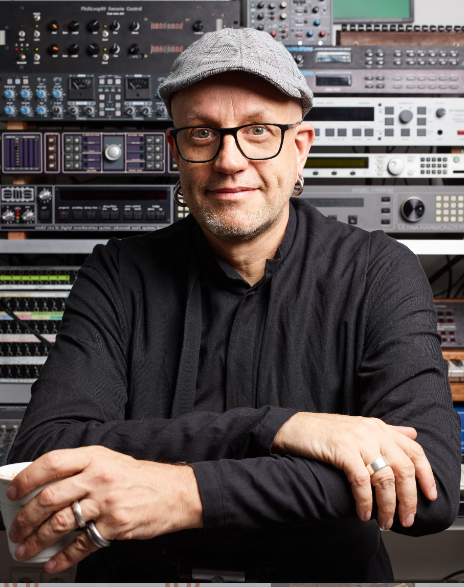
Robert Henke is a German software developer, hardware designer and sound technologist. He is one of the main creators of Ableton Live, the music software that became a standard for production and redefined live performance of electronic music, and he was actively involved in its development from 1999 to 2025. To Ableton Live he contributed his own instruments and effects, including Operator, Beat Repeat and Grain Delay, and he built Granulator, a granular synthesizer for Max/MSP for Live that is now in its third version. On the hardware side he designed the Monodeck MIDI controllers for Ableton Live and a Firebird, a 6502-based 8-bit computer.
Table of Contents
With Ableton Live, what problem did you solve? What was lacking in the ‘status quo’ of available sequencers at the time?
All major music production software before Live was based on the idea of using a computer as an elaborated multi-track recorder. Our software was meant for <i>performing</i> music using the computer as an <i>instrument</i> and this paradigm shaped every detail of it. II created a lot of the effects in the early Live versions, the Chorus, the EQ, and such things.
You built the Chorus and EQ with a very limited CPU. How do you design an effect when every operation counts?
By being naive. This helped a lot. Instead of using six modulated stereo delay lines and doing complex interpolation and filtering and such things, I build the chorus using four delays in total and no filtering at all. And I added a playful 2D interface to control depth and frequency of the modulation. Simple but effective. The EQ started with a very basic filter algorithm and got much better over time, when more CPU resources were available. The Chorus stayed untouched for 20 years….
You and Gerhard were already using Max in the 90s. How did working in Max shape the ideas behind Ableton Live?
Max allowed us to build structures like step-sequencers which offered a more playful approach to music and that allowed us to interact with them whilst they were playing, putting the artist more in the role of a conductor than a musician. Live’s Session View is the direct result of that.
What did the first step-sequencer prototype look like, and when did you know the idea worked?
The first sequencers Gerhard and I wrote for our own music were just Max patches and they looked like all Max patches of that time: messy and with a lot of wires. For Live, the challenges were more on the technical side: How many tracks of audio can we run at the same time, how much CPU can we dedicate for a reverb, how fast is the average harddisk, how can we build a user interface that works with a small computer screen, and such things.
You contributed instruments and effects like Operator, Beat Repeat and Grain Delay. How did you decide which tools belonged inside Ableton Live, and which were better left for others to build?
Such decisions are always a mix of pragmatism and personality. It was clear that we would need an EQ, a compressor, some delays etc. It was also clear that CPU at this time was quite limited and as a result our effects were quite simple, which in retrospect turned out to be a good thing, it helped focusing on what to do with them in a musical context rather than getting lost in infinite parameter space. Some tools of course also reflect personal interest. The Grain Delay I made because I wanted such an effect for my own music, and I thought others might like it too. The same goes for Erosion, a quite simple yet unique effect.
You said simple effects kept the focus on music. Do today’s much larger CPU budgets make tools worse in that sense?
It makes it harder to decide, yes. It takes discipline to deliberately reduce options. But it is necessary to achieve any outcome. The question when creating in the past often was: is it enough? Now the question is more: Is it too much already?
Ableton Live grew from a small team into a product used by millions. When did you realize how big it would become, and how did the team handle that growth?
We never really realised it, it just happened. And we were very cautious about it, because the software itself was not very complex at the beginning, and a company like Roland or Yamaha or any other big player could have come up with something very similar any time, but with much more people involved in the development. We thought this is going to work for a while and then there will be stiff competition. It did not really happen, until our user base became so big that it had its own momentum. It was also always clear to us that we are not interested in selling the company but rather want to stay independent. That also helps putting a cap on things.
You worked on Ableton Live for 26 years, until 2025. What was it like to step away from something you helped create?
Actually it was always a dance around the company, from the start. I see myself primarily as an artist, who has a strong interest in technology, user interfaces, code… It was clear to me from the beginning that I have to find a way to reserve time for my art. There were episodes with very strong ties to the company and a lot of involvement and others where I did focus on my music or audiovisual works. I will probably never be completely out of it, and perhaps I am going to be involved again in 2027 or 2028 and focus on some specific topic, who knows. My ‘problem’ is that I am using our product pretty much every day, and that makes it impossible not to think about how it could evolve.
Max for Live brought Max into Ableton Live. What was your role in it, and how did Granulator come out of that work?
I was a strong advocate for the original idea. I thought it could be powerful and open a lot of doors – which it did. It was and is a challenge to integrate two quite complex products into one thing, but I think we managed quite well, and for instance most of my performance pieces would be impossible to do without Max for Live. Granulator: I built a granular synth already in 2000, long before Max For Live. It was just the perfect candidate to integrate, and hence I did.
Which of your performance pieces would be impossible without it, and what does it do?
All my performances with the exception of CBM 8032 AV which entirely runs on 8 bit CPUs from 1976.
You worked on granular synthesis for over a decade. Can you explain to the rest of us what granular synthesis actually is, and what kind of product is your Granulator?
The conceptual idea is old, and quite simple: Let’s imagine the spoken word ‘Test’. It takes around 0.4 seconds to say it. You can chop that time into smaller parts: You take a snippet at 0.1 seconds which is 0.05 seconds long and repeat this. You will probably get something that sounds like a frozen letter E. When you repeat a longer part of the word, you get a more rhythmical texture, like TeTeTeTeTe…. Or stststststst. When you repeat a shorter part, you get into a region where it does not sound like the source at all. Granular synthesis is based on the idea of cutting a recording into tiny ‘grains’ and re-arranging them in time. This allows us to derive all kinds of interesting sounds from a source. Like turning that word ‘Test’ into a choir singing “E” or a recording of your cat into a giant lion. Granulator is an instrument that allows you to do all those things, in a musical context, inside Ableton Live.
You designed the Monodeck MIDI controllers and built the Firebird 8-bit computer. Why build your own hardware when so much is available?
Because it is fun, because I know how to do it, and because if something is effortful, one is more likely to make sense of the results. It is kind of the opposite of the current idea of prompt based music generation. If I spend six months soldering, I need to have a really good idea beforehand what I want to achieve and how I am going to use what I am doing. There is a big chance that I will explore my work in depth and come up with very personal results afterwards.
You build your own tools. Do they shape your sound more than the tools everyone else uses?
No. I could achieve the same results with other tools. It is just that building tools help me shape my idea first. But of course there is a deep satisfaction when using them. Beautiful instruments make it definitely more fun to be creative. It does not have to be my own ones, a lot of the great electronic instruments on the market radiate the dedication of their creators.
Which build took the longest, and what did it teach you?
Hard to say. I spent several years programming assembler for the CBM 8032 AV project, but I also spent an equal amount of time writing the laser control software for FIRST LIGHT…
Many producers now use the same software, and some say music is starting to sound alike. Is that a risk of standard tools, and how do you avoid it?
I think I gave the answer already. It is not the tools, it is what you make with them. No one would question that it is still possible to write new novels, using the alphabet.
Modern DAWs are becoming cloud-based and AI-assisted. Where is the line between a tool that helps and a tool that takes over the creative decision?
There is no general answer here, and the field is developing so fast that whatever I might say might be obsolete when this is published. I personally don’t like the idea of using tools which were created scraping the output of pretty much every artist on this planet without consent. This is unethical. But then again, I am using Claude to assist me with coding these days, and one could find similar arguments here. It is not black and white and AI is becoming part of the artistic process in one way or the other. My positive outlook: artists, especially upcoming, young ones, will always find their ways to subvert technology and I am looking forward to what this will bring us.
What do you tell young musicians and developers who want to build their own tools, not only use existing ones?
If you like the challenge and have fun doing it, go for it!
Where can people follow your latest work, lectures and releases?
I maintain a website since 1999 with a lot of love and dedication and it is permanently growing and updated: roberthenke.com
Robert Henke performing his interactive work ‘FIRST LIGHT; an interactive surround
laser audiovisual performance, more of his works here: roberthenke.com
Upcoming Events:
Nov 7 – FIRST LIGHT – UK – London – Concert Hall – Barbican
Jan 8 – FIRST LIGHT – NL – Amsterdam – Muziekgebouw – Fiber X
Feb 18 – FIRST LIGHT – LT – Vilnius – Compensa koncertų salė – (link)
Mar 13 – FIRST LIGHT – HU – Budapest – Müpa Budapest
Past Events
selected musical and audiovisual performance works
2026 FIRST LIGHT
2022 Monolake 8bit
2019 CBM 8032 AV
2018 From Within…, with Marko Nikodijevic
2017 Lumiere III
2016 Deep Web, with Christopher Bauder
2015 Lumiere II
2013 Grid, with Christopher Bauder
2013 Lumiere
2011 Dust
2011 Fundamental Forces, with Tarik Barri
2009 Monolake Live Surround, with Tarik Barri
2007 Layering Buddha Live
2007 Atom, with Christopher Bauder
2005 Studies For Thunder
2002 Atlantic Waves
1997 Monolake Live, with Gerhard Behles
1996 Symmetrisches Konzert, with Gerhard Behles
computer graphics & digital image processing
2024 Noise Patterns, more …
2022 Noise Patterns
2014 Landscape
selected exhibitions
2025 Monopol, Berlin, Germany
2020 Schloss Herrenhausen, Hannover, Germany
2020 D-Museum, Seoul, Korea
2020 Philharmonie, Berlin, Germany
2019 Zollverein, Essen, Germany
2019 Espacio Fundacion Telefonica, Lima, Peru
2018 Sala Santa Rita, Rome, Italy
2017 Palazzo delle Esposizioni, Rome, Italy
2017 Dampfzentrale, Bern, Switzerland
2016 LEV Festival, Gijon, Spain
2016 Kraftwerk, Berlin, Germany
2015 The Lowry, Manchester, England
2015 Zollverein Mischanlage, Essen, Germany
2015 Krake Festival, Berlin, Germany
2015 STRP Biennale, Eindhoven, Netherlands
2014 Bibliothek Nationale, Rennes, France
2014 Kunstwerke, Berlin, Germany
2014 Le Fresnoy, Lille, France
2014 Stony Brook University, New York, USA
2012 Le Lieu Unique Nantes, France
2012 Grosser Wasserspeicher, Berlin, Germany
2012 International Digital Arts Biennial, Montreal, Canada
2012 MAK, Vienna, Austria
2011 Musikprotokol, Graz, Austria
2011 Fargfabriken, Stockholm, Sweden
2010 Klang im Raum, Berlin, Germany
2007 Dis-Patch Festival, Belgrade, Serbia
2007 MUDAM Luxembourg and Philharmonie Luxembourg
2004 Singuhr Hörgalerie, Berlin, Germany
selected software
2025 FirstLightEngine, MaxMSP, laser control
2023 Granulator III, Max4Live, synthesizer plugin for Ableton Live
2020 PitchLoop, Max4Live, effect plugin for Ableton Live
2017 Phosphor Engine, MaxMSP, laser control
2017 Lumiere LaserGenerator III, MaxMSP, laser control
2017 Spline Engine, MaxMSP, laser control
2016 Fall Engine, MaxMSP, laser control
2015 Lumiere LaserGenerator II, MaxMSP, laser control
2014 Ritual Engine, MaxMSP, generative sound engine
2013 Lumiere LaserGenerator I, MaxMSP, laser control
2012 Fragile Territories Engine, MaxMSP, laser control
2010 Granulator II, Max4Live, synthesizer plugin for Ableton Live
2010 Custom step sequencer, Max4Live Device and Max patch, for Sam Shackleton
2007 Granulator, Max4Live, synthesizer plugin for Ableton Live
2002 Atlantic Waves engine, networked Max patch
2000 – 2005 effects and instruments in Ableton Live: Beat Repeat, Vinyl Distortion, Simpler, Operator, Erosion, Grain Delay, Filter Delay, Chorus, EQ4
1996 PX18, step sequencer, Max patch
selected hardware
2024 Firebird DAC, dual 8bit DAC and speech synthesis
2023 PitchLoop Remote, effect processor front end
2023 RMX16-c, convolution hardware front end
2021 Firebird, 8bit computer, 6502 based, for CBM 8032AV shows
2019 – 2022 CBM 8032 DAC (revisions 1…5)
2018 CBM 8032 Video Out, with Ralf Suckow
2018 CBM 8032 network nodes
2006 Monodeck II, MIDI controller for Ableton Live, with Ralf Suckow
2003 Monodeck I, MIDI controller for Ableton Live
selected performances
2023 Modena20232024, Modena, Italy
2023 Monolake 8bit, OHM, Berlin, Germany
2020 CBM 8032 AV, Amsterdam, Holland, Muzikgebouw
2020 CBM 8032 AV, London, England, Barbican Concert Hall
2019 CBM 8032 AV, Premiere, Unsound Festival, Krakow, Poland
2019 Venice Dust, Palazzo Grassi, Venice, Italy
2018 From Within…, Cité de la Musique, Paris, France
2017 Lumiere III, Teatro Argentina, Rome, Italy
2017 Lumiere III, Premiere, Barbican Centre, London, England
2016 Lumiere II.2, ICMC Conference, Utrecht, The Netherlands
2016 Deep Web, with Christopher Bauder, Kraftwerk, Berlin, Germany
2015 Dust, Acousmonium Version, Presence Electronique Festival, Geneva, Switzerland
2015 Lumiere II.2, Voelksbühne, Berlin, Germany
2015 Lumiere II.2, Recital Centre, Melbourne, Australia
2014 Lumiere, Barbican, London, United Kingdom
2014 Fundamental Forces FF05, Live, IRCAM, Paris, France
2013 Lumiere, Unsound Festival, Krakow, Poland
2013 Stanford Dust, Stanford University, Palo Alto, USA
2012 Iron Age, Sonar Festival, Barcelona, Spain
2012 Dust, Tau Acousmonium Versions, 104, Paris, France
2011 Dust, ZKM, Karlsruhe, Germany
2011 Tau WFS Version, Technical University, Berlin, Germany
2011 ATOM, Mexico City, Mexico
2010 Monolake Live Surround, EMPAC, Troy, USA
2008 Layering Buddha, Planetarium Melbourne, Australia
2008 Layering Buddha, Art Gallery of New South Wales, Sydney, Australia
2008 ATOM, Centre Pompidou, Paris, France
2007 Layering Buddha Live, Museo Nacional Centro de Arte Reina Sophia, Madrid, Spain
2005 Monolake Live, PS1/MOMA, New York, USA
2005 Studies for Thunder, MUTEK Festival, Montreal, Canada
2004 Monolake Live, Museum of Contemporary Art, Vilnius, Lithuania
2004 Atlantic Waves, Tate Modern Turbine Hall, London, United Kingdom
2002 Monolake Live, Central Park Summerstage, NYC, USA
2002 Monolake Live, ZKM, Karlsruhe, Germany
2001 Monolake Live, Metamorphose Festival, Mount Fuji, Japan
2001 Monolake Live, Institute of Contemporary Art, London, United Kingdom
2000 Monolake Live, Dutch Electronic Arts Festival, Rotterdam, Netherlands
2000 Monolake Live, Festival of Visions, Hong Kong, China
recognitions / residencies
2026 Residency Villa Massimo, Rome, Italy, 2027/2028
2023 Best Production, 67th Intl. Festival of Contemporary Music – La Biennale di Venezia
2019 Artist in Residence, Corte Supernova / Palazzo Grassi, Venice, Italy
2015 ILDA award for Destructive Observation Field installation
2013 ILDA award for Fragile Territories installation
2013 Artist in Residence, Le Fresnoy, Lille, France
2013 Honorary Mention for Works for Wave Field Synthesis, Prix Ars Electronica, Linz, Austria
2013 Mohr Visiting Artist, CCRMA, Stanford University, CA, USA
2012 Artist in Residence at Electroni[k] Festival, Rennes, France
2010 Artist in Residence, EMPAC, Troy, USA
2007 Artist in Residence at Tesla Media Laboratory, Berlin, Germany
2007 Artist in Focus at Dis-Patch Festival, Belgrade, Serbia
2007 Honorary Mention for Layering Buddha, Prix Ars Electronica, Linz, Austria
selected talks
2026 ICMC, Hamburg, Germany
2015 LOOP, Berlin, Germany
2014 STEIM, Amsterdam, Netherlands
2014 IRCAM, Paris, France
2014 IMM, Düsseldorf, Germany
2014 Folkwang University, Essen, Germany
2014 CTM, Berlin, Germany
2013 Ultima Festival, Oslo, Norway
2013 Goethe Institute, Dublin, Ireland
2013 SETI Institute, Mountain View, USA
2013 MUTEK, ES, Barcelona, Spain
2013 UCC, Cork, Ireland
2012 STEIM, Amsterdam, Netherlands
2012 Laboratorio / Arte Alameda, Mexico City, Mexico
2012 Decibel Festival, Seattle, USA
2012 PNCA, Portland, USA
2012 MUTEK Montreal, Canada
2012 Goethe Institute, NYC, USA
2012 IET lecture, London, United Kingdom
2010 EMPAC, Troy, USA
2010 CalArts, Los Angeles, USA
2010 DU, Denver, USA
academia
2015 Lecturer, CCRMA, Stanford University, USA
2013–2014 Professeur Artiste, Le Fresnoy, Studio National Des Arts Contemporains, Lille, France
2013 Artist in Residence / Lecturer, CCRMA, Stanford University, USA
2013 External PhD examiner, Department of Music, UCC Cork, Ireland
2009–2012 Professor for Sounddesign, Berlin University of the Arts, Berlin, Germany
selected publications
2024 About the work of Andreas Gysin, in “On NFTs”, Taschen
2013 “Monitoring for Laptop Performers”, online, roberthenke.com
2011 “Tod durch Überfluss, Was tun wenn alles möglich ist?” in Neue Zeitschrift für Musik, Ausgabe Februar 2011
2009 “Live Performance in the Age of Supercomputers Part II”, online, roberthenke.com
2008 “Mastering”, Interview with Rashad Becker (online, reprinted in DotDotDot magazine, NYC)
2007 “Live Performance in the Age of Supercomputers” (online, reprinted in various festival catalogues)
2005 “Live Performance” in Techno Visionen – New Sounds, New Image Spaces, Medienturm Graz, Folio Verlag
work and education
2023–2025 Strategic planning, product development, Ableton AG, Berlin, Germany
2011–2023 Consultant, Ableton AG, Berlin, Germany
1999–2011 Instrument and effects design, product development, Ableton AG, Berlin, Germany
1997–1999 Mastering engineer, Dubplates & Mastering, Berlin, Germany
1995–1996 Sound engineer, Berliner Ensemble theatre, Berlin, Germany
1994–1995 AVID student supervisor, HFF Babelsberg, Potsdam, Germany
1992–1995 Sound engineering, HFF Babelsberg, Potsdam, Germany
1992 Studio technician, EMG, Berlin, Germany
1991–1992 Computer science, Technical University, Berlin
1988–1990 Studio technician, BOA Videofilmkunst, Munich, Germany