


Greenhouse collapse: snow, knots and a failed digital twin
Last winter, the spatial structure of the botanical greenhouse gave way due to widespread buckling of the nodes. The cause was an asymmetric overload of wet snow that accumulated stress at critical points. The incident, captured on video, has led engineers to digitally reconstruct the collapse to understand how a design that seemed robust failed.
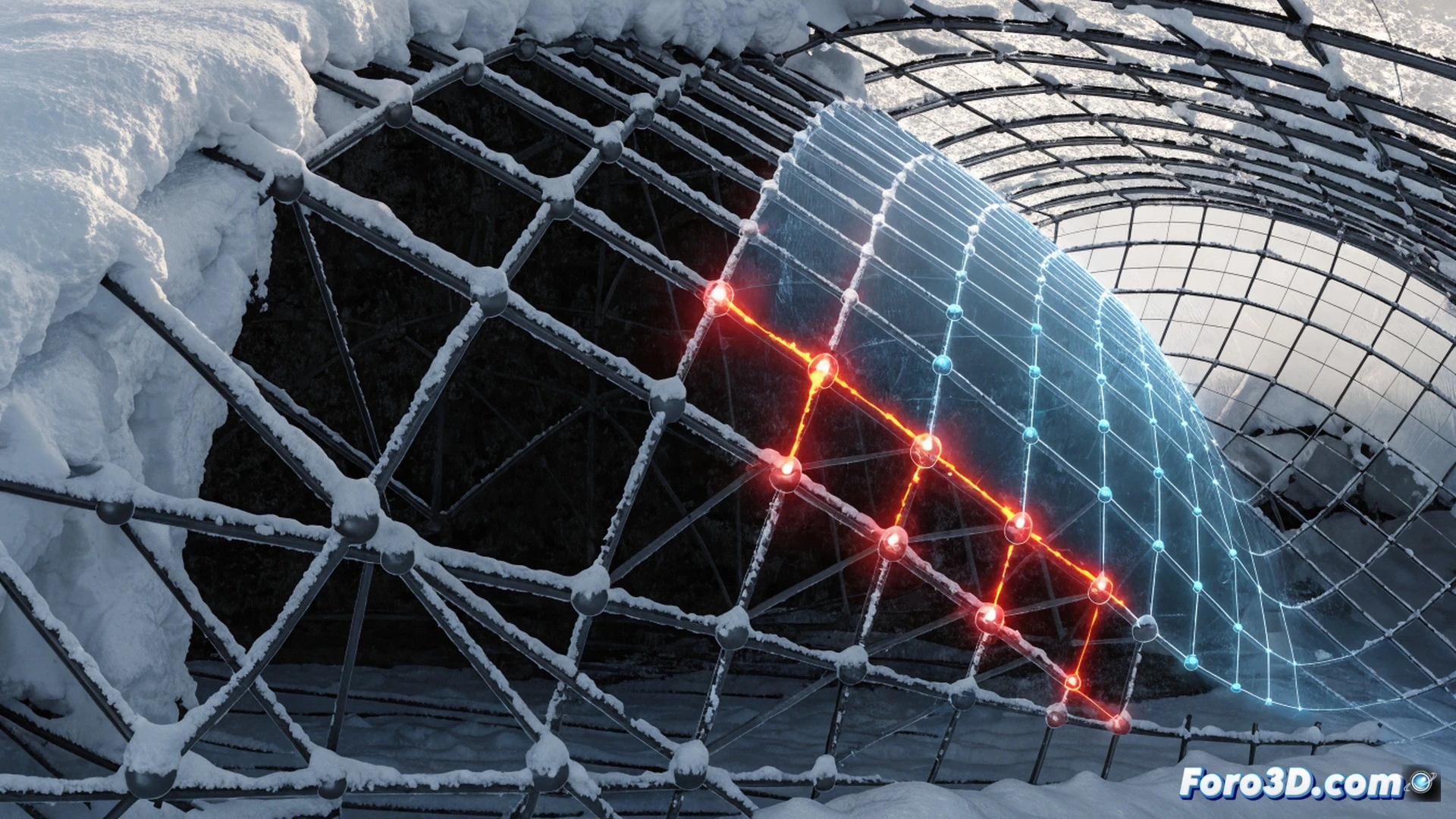
Forensic pipeline: from point cloud to finite element analysis 🛠️
The forensic team used RealityCapture to generate a precise point cloud of the collapsed greenhouse, capturing the deformation of each node and bar. This model was imported into Ansys, where the snow loads recorded by weather stations were applied. The finite element analysis revealed that the load asymmetry generated unforeseen torsional moments, exceeding the capacity of the spherical nodes and triggering a progressive chain buckling.
The snow that spares not even spherical nodes ❄️
It seems nature didn’t read the design manual. While engineers calculated uniform loads, the snow decided to pile up on just one side, like a cat that lies down exactly where it shouldn’t. The nodes, which in theory were indestructible, bent like wet spaghetti. Now, the digital twin will serve to redesign, but wet snow will remain the boss.
Read more here: Source link