


3D Reconstruction of Propeller-Dock Collision: Forensic Analysis
The recent collision incident between a propeller and a dock poses a technical challenge for accident reconstruction. Beyond the initial report, precisely determining the sequence of events requires rigorous spatial analysis. The combination of photogrammetry and finite element simulation allows investigators not only to visualize the impact but also to quantify the forces involved and establish responsibility based on objective data, not subjective testimonies.
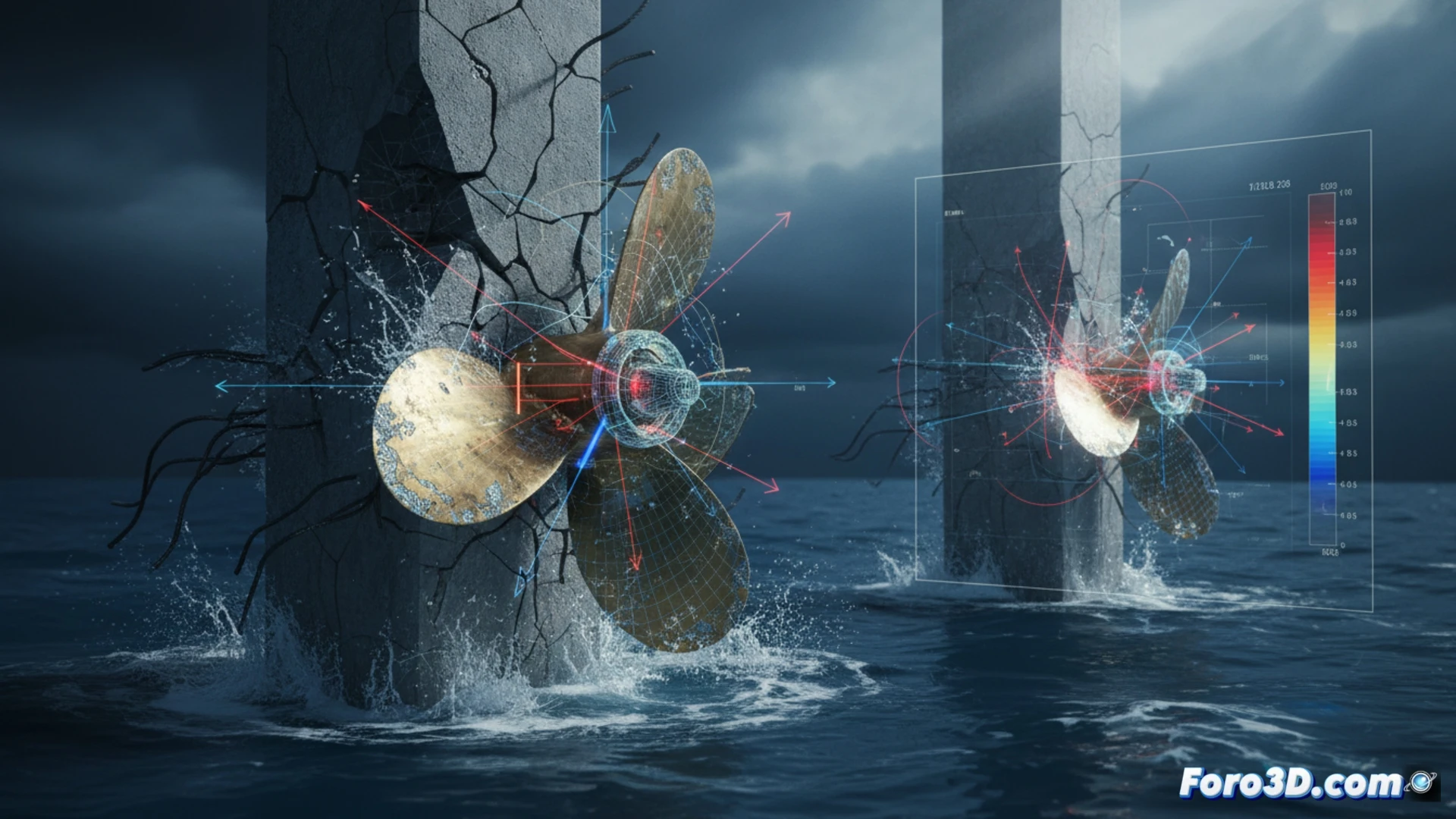
Scanning and simulation methodology of the impact 🛠️
The first step involves capturing the geometry of the dock and propeller using terrestrial laser scanning or drone photogrammetry. Point clouds with millimeter precision are generated to model deformations and friction marks. Subsequently, these models are imported into computational fluid dynamics and rigid body simulation software. The vessel’s trajectory is recreated, adjusting parameters such as rotational speed, angle of attack, and draft depth. The simulation reveals the exact contact points, stress distribution in the dock material, and the kinetic energy dissipated during the collision. This analysis allows distinguishing between a prior mechanical failure and a maneuvering error.
Lessons for port infrastructure design 🚢
The virtual reconstruction not only clarifies the incident but also provides crucial data for prevention. By identifying the dock area that suffered the highest dynamic load, engineers can reinforce those points with elastomeric fenders or impact absorption systems. Likewise, the 3D model serves as expert evidence in litigation, eliminating ambiguities. In the field of nautical safety, this case underscores the need to integrate proximity sensors on propellers and update docking protocols when current and wind conditions are adverse.
Which structural deformation parameters and dock material conditions should be prioritized to achieve an accurate 3D reconstruction that discriminates between the propeller impact and possible pre-existing damage in a forensic collision analysis?
(PS: In scene analysis, every scale witness is a small anonymous hero.)
Read more here: Source link